Antichamber: A cerebral first-person puzzle experiment
Antichamber, by Alexander Bruce, is a first-person psychological exploration game that forces players to question spatial logic. You traverse an abstract environment, solve lateral-thinking puzzles, manipulate objects to alter traversal, discover shortcuts by reframing spatial assumptions, and learn device behaviors that change movement through experimentation. Minimalist tone, experimental puzzle design, lack of combat, philosophical prompts, and thoughtful pacing encourage reflective play rather than action-focused mechanics. It suits players who enjoyed Portal and prefer conceptual, single-player puzzle sessions.
What kind of game is it?
Step into a setting where choices reshape consequence and curiosity becomes the principal motive for progress. The game forgoes combat and conventional plot beats, relying on environmental storytelling and isolated encounters to motivate exploration. There is no death or failure state, so falling or getting lost relocates you rather than ending the run. The design privileges observation and mental reframing, making discovery the primary reward rather than timed challenges.
Does it have a multiplayer mode?
The experience is single-player only. The Matter Gun functions as the primary puzzle device, letting players pick up, carry, and place colored cubes to build platforms, block lasers, or trigger switches. The game autosaves progress automatically; pressing Escape returns to the Antechamber hub that acts as a fast-travel map to any previously visited room. Puzzles emphasize placement and spatial manipulation rather than inventory management or resource grinding.
What does it look like and how does the world hold together?
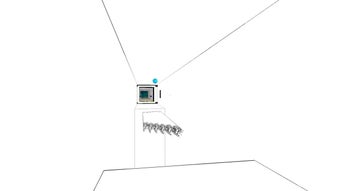
Visuals use stark geometry and high-contrast motifs: vast white surfaces, bold black lines, and primary colors that mark interactive elements and orientation. The world employs impossible, non-Euclidean construction so sightlines and corridors can connect in counterintuitive ways. There are no loading screens once you begin, preserving continuity as you move through the maze. More than one hundred hidden wall signs scatter cryptic advice and brief philosophical reflections.
Is it hard to get started?
Onboarding is deliberately light, so early puzzles require abandoning learned heuristics and thinking spatially instead of procedurally. Later challenges compound earlier lessons, asking players to combine tools and observations across distant rooms, which creates frequent 'aha' moments when counterintuitive tactics work. User feedback notes the abstract presentation and limited explicit guidance as entry barriers for some players. The title began as a mod and, after roughly seven years of solo development by the developer, earned numerous industry awards.
Final assessment for thoughtful puzzle players
The game is a cerebral choice for players who enjoy puzzles that force them to rethink spatial assumptions and accept ambiguity. Those who like reflective problem-solving and intermittent 'aha' moments find it satisfying; players who prefer explicit instruction or steady hand-eye tasks may struggle. For contemplative single-player sessions focused on conceptual challenge, it stands as a distinct and thought-provoking alternative. It rewards patience and curiosity.